She loves it, turning her head in the mirror, taking a photo for her story, telling you it is the best her color has looked in a year. She taps the card reader, says “I will text you,” and walks out. Six weeks later her roots are showing and she is booking with whoever has a Thursday opening. Sometimes that is you. Often it is not. Nothing went wrong in the chair. She just left without the next appointment on the book, at the moment she was happiest to make it.
Here is the answer first. Clients do not fail to rebook because they were unhappy. They fail because nobody asked at the one moment they would have said yes: while they are still in the chair and still thrilled. The fix is a six-part system. Plant the next visit mid-service, close it at checkout before they pay, make the booking one tap, run an automated net for the ones who slip, win back the ones who drift, and track your rebooking rate so it never slides. Each part below has the words to say and how it breaks.
Key takeaways (the TL;DR)
- A client who does not rebook is almost never unhappy. They left before anyone asked, at the moment the answer was yes.
- Checkout is the moment, not a follow-up text. Satisfaction peaks in the chair, so ask before they walk out.
- Offer a specific day and time, never “want to rebook?” An open question gets “I will text you.” A concrete slot gets a booking.
- Make the next slot one tap. A booking link rebooks now; “call us to schedule” never gets the call.
- The automated net is a backstop, not the plan. Nudges catch the slips; the in-chair ask is where the money is.
- Track rebooking rate per stylist, or it drifts. What you do not measure slides back within a month.
Table of contents
- Why clients walk out without rebooking
- What a one-time client costs you
- Part 1: Plant it in the chair
- Part 2: Close it at checkout
- Part 3: Make the next slot one tap
- Part 4: The automated net
- Part 5: Win back the ones who drift
- Part 6: Track the rebooking rate
- Three scenarios: solo, five, twelve chairs
- The legal fine print
- Objections
- FAQ
Why clients walk out without rebooking
Left to themselves, clients book when they notice a problem, not when it starts. The cut does not look wrong at four weeks, so they do not think about it. By week seven the shape is gone, and urgent means whoever is open. A happy client fully intends to come back, but intention is not a booking, and the gap between the two opens in the thirty seconds between the mirror and the door.
Industry guidance is blunt about where to close it: the checkout counter is the strongest rebooking moment, because the client is happiest and the service is fresh (Rework, Mindbody). Wait until they are home and you compete with their inbox and every other salon.
What a one-time client costs you
A missed rebooking feels like nothing. But the people running these chairs feel it. Across barbers, hairstylists and cosmetologists there were about 670,800 jobs in 2025, and a large share are not salaried staff: 80% of barbers and 48% of hairdressers and cosmetologists are self-employed, per the Bureau of Labor Statistics. For most of the trade, an empty slot is the operator’s own paycheck that did not happen.
Say a color client books every six weeks at a $120 ticket. On cadence that is eight or nine visits a year, a bit over $1,000. Lose her to the “I will text you” gap after one visit and you did not lose $120, you lost the year.
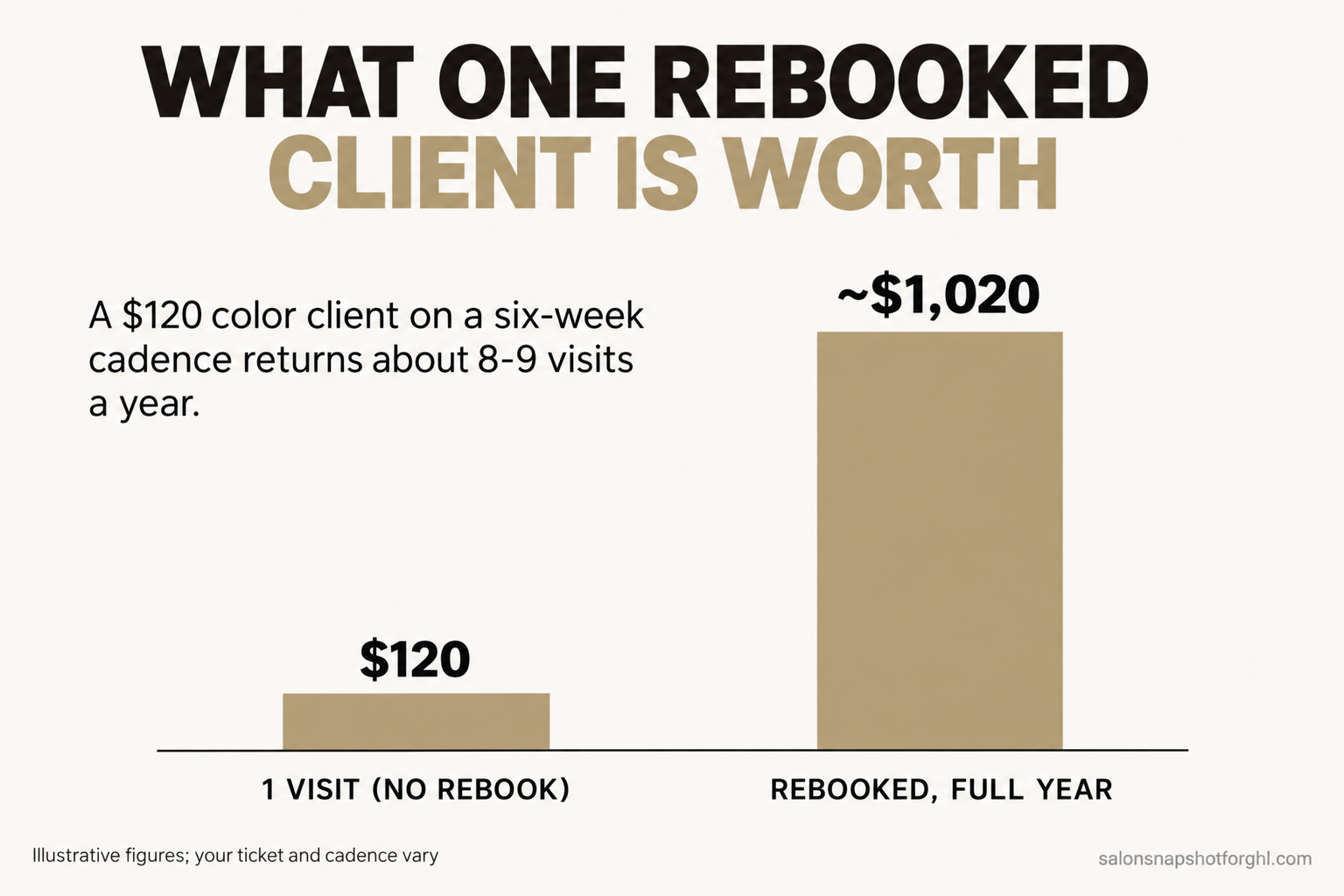
The scale is the point: a rebooking system keeps relationships you already earned, the cheapest growth there is, because you paid to win them once.
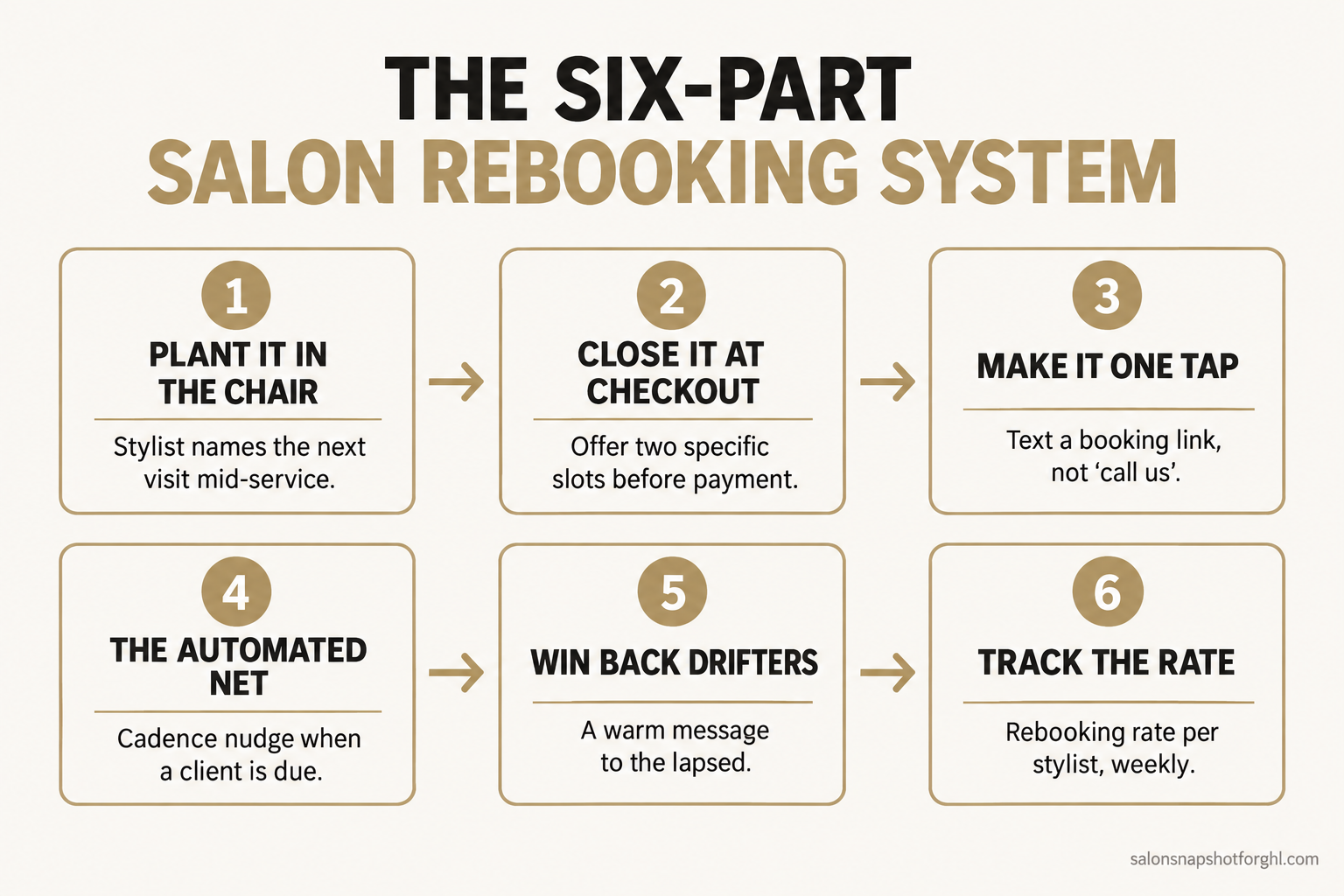
The first three parts are the live close; the last three are the safety net and scoreboard that keep it honest.
Part 1: Plant it in the chair
Rebooking does not start at the desk. It starts in the chair, mid-service, in the stylist’s voice. The stylist has the trust and knows the hair, so the stylist names the next visit first, as a professional recommendation, not a sales pitch. Tie it to the hair, not the calendar: “This balayage looks its best for about ten weeks, then we refresh the money pieces” lands as expertise. The scripts say the same: the stylist raises the next visit during the service, the desk proposes the date (Meevo).
Set it up. Train every stylist to say the interval out loud before the client leaves the chair, tied to the service. Cut clients hear six weeks, color clients hear their color interval, a fade hears three to four weeks.
How it breaks. The stylist forgets, or treats it as the desk’s job, so the client reaches checkout cold. Make the in-chair plant a non-negotiable habit. If it only happens when someone remembers, it will not happen on your busiest day, when it matters most.
Part 2: Close it at checkout
This is the part most shops skip, and the one that does the work. You do not ask whether the client wants to rebook. You offer a specific slot matching the interval the stylist named, and book it before you take payment. Platforms agree: rebook before the bill, because once the card is run the client is halfway out the door (Slick).
“Do you want to schedule your next one?” invites “I will check and text you,” which means no. A concrete offer invites a yes or a small tweak. Here is the front-desk close, nearly verbatim, to hand your team today:
“You are all set. Sarah wants to see you back in about six weeks to keep that color fresh, so the week of the 24th. I have Thursday the 27th at 10, or Tuesday the 25th at 2. Which works better?”
It offers two slots instead of an open calendar, so the client chooses between times, not between yes and no.
Set it up. Give the desk one rule: nobody checks out without being offered two specific slots first. Put the recommended interval where the desk can see it, on the ticket or in the booking system. Book it, confirm it, then take payment.
How it breaks. A line forms and rebooking becomes the step that gets dropped under pressure, or the desk offers a vague “sometime in six weeks.” Protect the two-slot offer as the step that never gets skipped.
Illustrative annual value of one color client at a $120 ticket: a single visit versus a six-week cadence of roughly 8.5 visits a year. Your ticket and cadence change the figures.
Part 3: Make the next slot one tap
Some clients genuinely cannot commit at the desk. The rule is simple: never let them leave with “call us to book.” A client asked to phone during business hours means to, and does not. So the follow-up is a booking link. When the client says “let me get back to you,” the desk replies “no problem, I will text you the link so you can grab Sarah’s Thursdays whenever you know.” Now the ball is somewhere they can act on at 9pm. Here is the hold-the-slot text:
“Hi Maya, great seeing you today. Whenever you are ready for your next color with Sarah, tap here to grab a spot: [booking link]. She books about three weeks out, so sooner is easier. See you soon.”
Set it up. Every stylist and the desk need a one-tap link that drops the client into that stylist’s real availability, not a generic contact form. Our appointment automation module builds this, the same link you reuse for reminders and win-backs.
How it breaks. A dead or generic link kills it: if it lands on a homepage or the whole shop’s calendar, the client bounces. It goes to that stylist’s open times and nowhere else.
Part 4: The automated net
Even a sharp close and a good link miss some clients. Part 4 catches them: an automated nudge that fires when a client is naturally due, based on their last service and interval, with the booking link built in. It is the backstop, working because Parts 1 through 3 shrank the pile it handles. The nudge reads like the shop paying attention, because it is tied to that client’s real cadence, not a blast. For the full cadence logic, our six-week rebooking rhythm goes deep on timing. Here is the nudge for a client who did not pre-book:
“Hi Jordan, it has been about six weeks, so you are right on schedule for your next cut with Theo. Tap to grab your usual Thursday slot: [booking link]. Reply STOP to opt out.”
Set it up. Tag each client with their service and interval at checkout, and let the system send the nudge when they hit their due window. A CRM and workflow setup tracks the clock for every client. Keep reminder consent separate from marketing consent.
How it breaks. Firing too often trains clients to ignore you; blasting everyone at once feels like spam. Tie each nudge to the individual’s real due date, send it once, and let the link do the rest.
Part 5: Win back the ones who drift
Some clients slip past their interval entirely. The win-back is a later, warmer message for clients who have gone genuinely quiet, well past their normal gap. It is not for your regulars. Restraint is the whole game: a win-back that fires too soon becomes noise, and a client who was four weeks late feels nagged. Fired sparingly, at truly lapsed clients, it recovers people who would otherwise become someone else’s regular. Here is the win-back:
“Hi Priya, we have missed you at the shop. We would love to get you back in the chair with Sarah. Here is 15% off your next color to make it easy: [booking link]. No rush, good through the month.”
Set it up. Define “lapsed” as a real threshold past the normal interval, say color clients more than four weeks overdue, and let the system flag them. Send it once, with a small, genuine reason to come now. For clients who go cold after booking, pair this with your no-show process.
How it breaks. Sending it to clients who are not actually lapsed burns goodwill and discount margin. Keep the threshold honest and the offer small but real.
Part 6: Track the rebooking rate
What you do not measure slides. A shop drifts back to “I will text you” the first slammed week, and nobody notices until the calendar looks thin. The fix is a weekly number: of the clients who came in, how many left with their next appointment booked. Track it per stylist, because rebooking is a skill that varies chair to chair. Your strongest rebooker quietly runs a fuller column than your most talented cutter who never asks. Seeing the number by person lets you coach it and spot the slide early. Platform guidance agrees: measure retention overall and by staff member (Mindbody).
Set it up. Pull the share of checked-out clients who had a future appointment on the book when they left, weekly, by stylist. Most booking systems report this, and a CRM workflow can surface it automatically for the whole team to see.
How it breaks. A shop-wide average hides the stylist who never asks behind the one who always does. Review it weekly, name what you see, and the system stays sharp.
Three scenarios: solo, five, twelve chairs
The six parts are the same, but which ones carry the weight changes with your size.
The solo booth renter or suite operator. You are the stylist, desk and calendar, so there is no handoff to lose. Parts 1, 2 and 3 are almost all you need: name the interval, offer two real slots before they pay, text the link to anyone who cannot commit. The empty slot is your own paycheck, so the in-chair close is the most valuable habit you own.
The five-chair commission or booth-rent salon. The handoff between chair and desk is where rebookings die, and no one can track a few hundred clients across five columns. This is where the automated net earns its keep, and Part 6 matters most: five stylists means five rebooking rates, and the gap between best and worst is money you can close with coaching.
The twelve-chair or multi-stylist shop. Rebooking is now a management problem too. You have the volume to see patterns per stylist, so route coaching to the stylists who do not rebook at the chair. This is also the size where owning booking, follow-up and reporting as one system, rather than renting per-seat tools that meter every text, changes the economics; our salon software cost breakdown runs those numbers.
The legal fine print
Two of the six parts, the cadence net and the win-back, send automated texts, which puts you inside rules you cannot ignore. None of this is legal advice, so confirm your situation with a professional.
Business texting runs through the TCPA and A2P 10DLC. US business text traffic from a standard number has to be registered through A2P 10DLC or carriers will not deliver it, and the FCC’s TCPA framework requires clear consent. Capture opt-in at booking, keep reminder consent separate from marketing consent, and honor STOP instantly. Our SMS compliance guide for salons walks the registration, and the SMS automation module keeps you inside it. Email win-backs follow the FTC’s CAN-SPAM rules: a working unsubscribe and your physical address in the footer.
Who sends it matters if you rent chairs. If your stylists are booth renters, not employees, think carefully before your shop texts on their behalf, because it can blur the independent-contractor line. In California, licensed barbers and cosmetologists are tested under the state’s Borello standard (California DIR). We cover it in how to classify every chair in your salon.
Objections
“Won’t clients feel pressured if I push the next appointment at checkout?” Not if you frame it as the stylist’s recommendation. Offering two specific times is less pressure than an open “want to rebook?”, because you did the thinking for them. The ones who truly cannot commit get the link instead.
“I already pay for a booking app. Doesn’t it do this?” Most apps hold the calendar and send a reminder. Few wire the interval into the checkout screen, tag the client for a cadence nudge, and report rebooking rate per stylist as one connected flow. If yours does all of that, use it. If you are stitching three tools together and still losing clients, owning it as one system is usually cheaper.
“Do I need to be technical to run this?” No. Parts 1, 2 and 6 are habits and scripts: name the interval, offer two slots, check the number weekly. The automation only earns its keep on Parts 4 and 5 once you have more than a couple of chairs.
FAQ
Why don't my clients rebook even when they love their hair?
Loving the result and booking the next visit are two different actions, and most clients only do the first. They walk out intending to come back, but nobody offered a specific slot while they were in the chair and happy. The fix is to ask at checkout, with a concrete day and time.
What should I actually say to get a client to rebook?
Offer two specific slots tied to the interval the stylist recommended: 'Sarah wants to see you back in about six weeks. I have Thursday the 27th at 10 or Tuesday the 25th at 2, which works better?' A concrete offer gets a yes or a small tweak. An open 'want to rebook?' gets 'I will text you,' which means no.
How do I rebook a client who will not commit at the desk?
Never let them leave with 'call us to book.' Send a one-tap booking link that drops straight into their stylist's real availability, so they can grab a slot from the couch whenever they know their schedule. A client asked to phone during business hours rarely does; a link they tap at 9pm gets used.
Should I use automated texts to get clients to rebook?
Yes, as a backstop to the in-chair ask, not instead of it. A cadence nudge tied to each client's interval catches the ones who slipped through checkout. Keep it registered: US business texting requires A2P 10DLC registration and TCPA opt-in, with STOP honored instantly. This is not legal advice; confirm your setup with a professional.
How do I know if my rebooking is actually working?
Track the share of checked-out clients who left with their next appointment booked, every week, by stylist. Rebooking is a skill that varies chair to chair, so a shop-wide average hides your weak rebooker behind your strong one. A weekly number lets you coach the gap and catch a slide early.
Back to that client in the mirror
Picture the same afternoon, one system later. Before she taps the card reader, the desk offers Sarah’s Thursday at 10 or Tuesday at 2. She takes the Thursday, on the book before she pays. Had she hesitated, she would have left with a booking link, not a vague intention.
None of that took a bigger marketing budget. It took asking at the one moment the answer was yes, making the next slot easy to grab, and watching the number so the habit never slips. Win the clients once, then stop letting them walk out unbooked. That is the cheapest full calendar you will build.
Sources
- BLS Occupational Outlook Handbook: Barbers, Hairstylists, and Cosmetologists
- Rework: Rebooking Strategies for Salons
- Mindbody: Maximize revenue and retention at checkout
- Meevo: Scripts to rebook clients
- Slick: How to rebook a client
- FCC: Telemarketing and robocalls (TCPA)
- FTC: CAN-SPAM Act compliance guide
- California DIR: Independent contractor FAQ